Finding the Andromeda Galaxy (M31): The Farthest Thing You Can See With Your Own Eyes
There is a smudge of light in the autumn sky that has been quietly sitting there for your entire life, and for most of human history nobody knew what it was. It is a galaxy of roughly a trillion stars, about 2.5 million light-years away, and you can see it without any equipment at all. Light leaving it when you spot it tonight began its trip before our species existed. That is the Andromeda Galaxy, Messier 31, and October and November are the perfect months to meet it.
The catch is that most people never find it, because it does not look like the photographs. This guide covers how to locate it, what you will realistically see with your eyes, binoculars, and a telescope, and how to avoid the disappointments that make beginners give up on it.
What You Are Actually Looking At
M31 is the nearest large spiral galaxy to our own Milky Way. NASA’s skywatching notes put it at around 2.5 million light-years away and describe it to the unaided eye as a fuzzy patch of about magnitude 3.4. That brightness is respectable on paper, but the light is spread over a large area, which is why it behaves more like a faint cloud than a star.
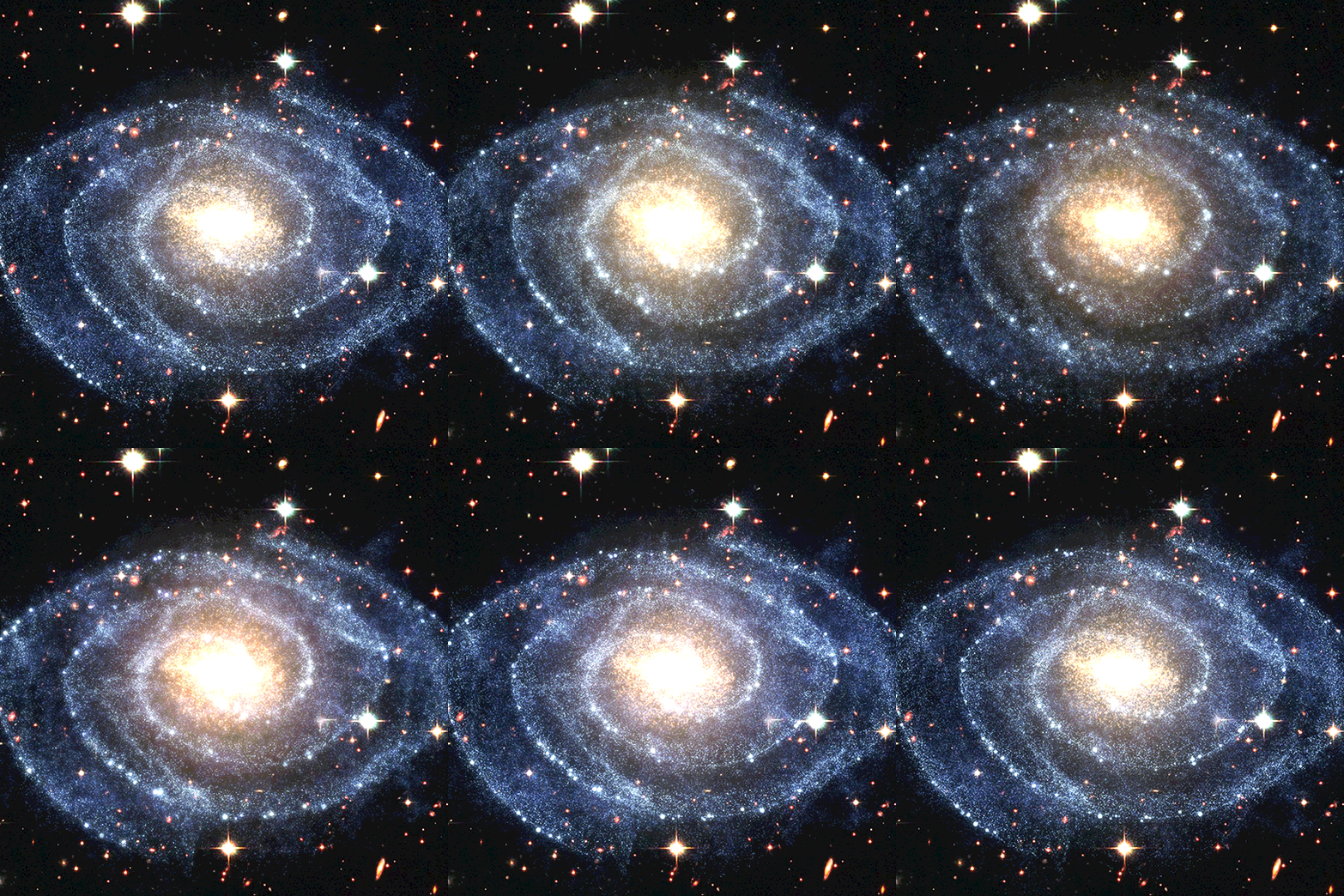
Here is the part that surprises people: Andromeda is huge. The full disc spans roughly three degrees of sky, about six full Moons side by side. Your eye and even most telescopes only catch the bright central region, which is why the galaxy looks small and modest at the eyepiece compared with long-exposure photos.
When and Where to Look
For Northern Hemisphere observers, Andromeda climbs high in the evening through autumn and is well placed after dark from roughly October into early winter. It sits high overhead in the evening hours, so you are looking through less haze and less atmosphere than you would with a low object. Pick a night when the Moon is a thin crescent or below the horizon. A bright Moon washes the galaxy out completely, so plan around the lunar cycle (our moon phases guide makes this easy).
Give your eyes at least 20 minutes to dark-adapt, keep your phone on a red-light setting, and get away from direct streetlights. If you can reach a darker site, do it. The Bortle scale guide shows how to find one near you, and our stargazing hub collects more beginner planning tips.
Two Reliable Ways to Find M31
The Great Square of Pegasus route
Find the Great Square of Pegasus, a large, fairly dim box of four stars high in the southeast to south on autumn evenings. One corner of the square, the star Alpheratz, is actually the head of Andromeda. From Alpheratz, a chain of stars curves away to the northeast: first Mirach, then a gentler turn up and left to a star called Mu Andromedae, and a little farther on, Nu Andromedae. M31 sits just beyond Nu, about the same distance again as Mu is from Mirach. Think of it as two steps from Mirach and one more small hop.
The Cassiopeia route
If the Great Square is hard to pick out under bright skies, use Cassiopeia instead. Its familiar W shape is easy even from a suburb. Andromeda lies in the sky just south of Cassiopeia, near the border of the two constellations, as NASA’s Night Sky Network describes, so start at the W and sweep gently toward the Great Square until you reach the string of Andromeda stars. Either way, once you are in the right area, look slightly off to the side of where you think it should be.
What You Will Actually See
With your eyes alone
Under a reasonably dark sky, M31 appears as an elongated, softly glowing patch brighter in the middle. From a suburb you may only catch the core as a faint smear, and from a city you may not see it at all. That is normal, not a failure on your part. NASA notes that even hints of it can show through light pollution, while a dark site reveals surprising amounts of detail.
With binoculars
This is where Andromeda shines for beginners. A pair of 7×50 or 10×50 binoculars gathers enough light to show a bright core and a hint of the saucer-shaped disc, and their wide field lets you take in far more of the galaxy than a telescope does. If you are weighing your first purchase, our binocular guide explains why they make such a good starting tool. In many binoculars you can also pick out the small companion galaxy M32 as a faint fuzzy star near the core, and M110 as a very faint oval on the opposite side.
With a telescope
A telescope shows more detail in the core but less of the whole picture. At high magnification M31 overflows the eyepiece and the faint outer regions disappear against the sky. Use your lowest-power, widest-field eyepiece. Under dark skies a moderate aperture can reveal a hint of a dark dust lane west of the core, but do not expect the colourful spiral arms you see in photographs. Human eyes cannot build up light the way a camera sensor does. If you need a telescope suited to this kind of work, our best telescopes for beginners guide is a good starting point.
Common Mistakes That Hide the Galaxy
The biggest mistake is expecting a photograph. Long exposures capture light your eye never accumulates, so the real thing is subtler, and that is fine. The second is using too much magnification, which dilutes the already faint glow. The third is observing too soon after stepping outside, before your eyes adapt. Finally, many people sweep right over M31 because it is large and low in contrast, so go slowly and relax your gaze.
Also remember that this is one of the few chances to see something that is a different galaxy entirely. Everything else you see with your naked eye on a given night, every star and nebula, belongs to our own Milky Way, with a few rare exceptions such as the Magellanic Clouds from the Southern Hemisphere. For more on the science, NASA has a helpful October skywatching note on catching Andromeda as it rises.
Frequently Asked Questions
Can I see the Andromeda Galaxy from a city?
Sometimes only the brightest core, and often not at all. Moving to a darker site, even just a nearby park away from direct lighting, makes a large difference. Binoculars help too.
Is Andromeda going to collide with the Milky Way?
The two galaxies are drawn toward each other by gravity, but any merger lies billions of years in the future, so there is nothing to worry about. Predictions have been refined over the years, so treat any specific date with caution.
What is the best time of night to look?
Any time it is high in the sky and the Moon is out of the way. On autumn evenings it climbs high after dark, and a few hours later it is near its highest point. Wait for a night with good transparency for the clearest view.
Once you have found Andromeda, you have done something remarkable: you have looked at another galaxy with your own eyes. Make a note of the date, sketch what you see, and come back in a different season to compare.