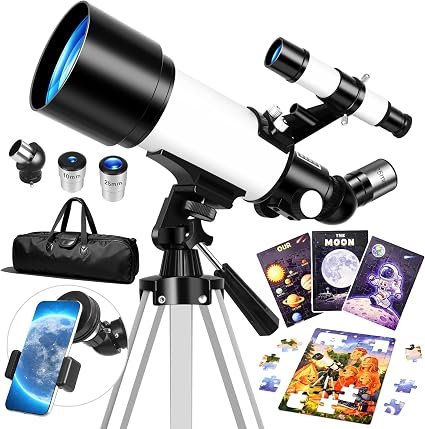
The Sky Explorer

Best Telescopes — Reviews & Buying Guide

Buying your first telescope shouldn’t require a physics degree. Here’s exactly what matters — aperture, mount, and budget — and what to skip.

🔬 Expert-Tested Reviews

💰 No Pay-to-Play Rankings

🔄 Updated Monthly

⭐ 4.9/5 Reader Rating

🎯 All Budgets Covered

Best Telescopes

Personally tested and ranked by our astronomy experts. Updated regularly with the latest models.

Some links on this page are affiliate links; we may earn a commission at no extra cost to you. See our affiliate disclosure — it never changes what we recommend.

Aperture Is the Number That Actually Matters

Aperture — the diameter of the main mirror or lens — determines how much light a telescope can gather, which determines how faint and detailed an object you can see. Magnification, the number retailers print in huge letters on the box, is nearly meaningless on its own: any telescope can be pushed to absurd magnifications, but without enough aperture the image just gets larger and dimmer. Useful magnification tops out around 50x per inch of aperture; beyond that you’re viewing a blur.

For visual observing of the Moon and planets, 70–90mm of aperture is a reasonable start. For faint deep-sky objects — galaxies, nebulae, clusters — you’ll want 130mm or more, which is why Dobsonian-style reflectors are so popular with budget-conscious beginners: they deliver the most aperture per dollar of any design.

The Mount Matters as Much as the Optics

A great telescope tube on a shaky, mismatched mount is one of the most common reasons beginner telescopes end up unused in a closet. Read our full breakdown of alt-azimuth vs. equatorial mounts before you buy — the mount is often the actual point of failure for frustrated new owners, not the optics.

Refractor, Reflector, or Compound?

Type Best for Trade-off
Refractor
Grab-and-go lunar/planetary viewing
Costs more per inch of aperture
Reflector
Deep-sky observing on a budget
Occasional mirror collimation, bulkier tube
Compound (SCT)
Compact aperture + GoTo tracking
Higher price, usually needs a computerized mount

Telescopes Worth Considering, by Budget

We don’t list live prices since they shift constantly — check current pricing before you buy.

Entry-level: Sky-Watcher Heritage 130p

A 130mm tabletop Dobsonian — collapsible, portable, and enough aperture to show real detail on the Moon, Saturn’s rings, and brighter deep-sky targets.

Mid-range: Orion StarBlast 6i / Celestron AstroMaster 130EQ

Larger reflectors that step up aperture noticeably while staying manageable to set up solo. Good once you’ve confirmed you’ll stick with the hobby.

Step-up: Celestron NexStar 8SE

An 8-inch Schmidt-Cassegrain on a computerized GoTo mount. Compact for its aperture, with auto-slewing that makes faint targets far easier to find from a light-polluted backyard.

Mistakes First-Time Buyers Make

Chasing magnification

“650x!” on a department-store box usually means a small lens pushed well past its useful limit.

Buying too much scope

The best telescope is the one that actually gets used. Too heavy to carry outside means it stays in the closet.

Ignoring the mount

Then blaming the optics when the view shakes at every touch.

Skipping a finder upgrade

Makes aiming at anything beyond the Moon needlessly frustrating. See our accessories guide.

Frequently Asked Questions

Quick answers to the most common questions from beginner astronomers.