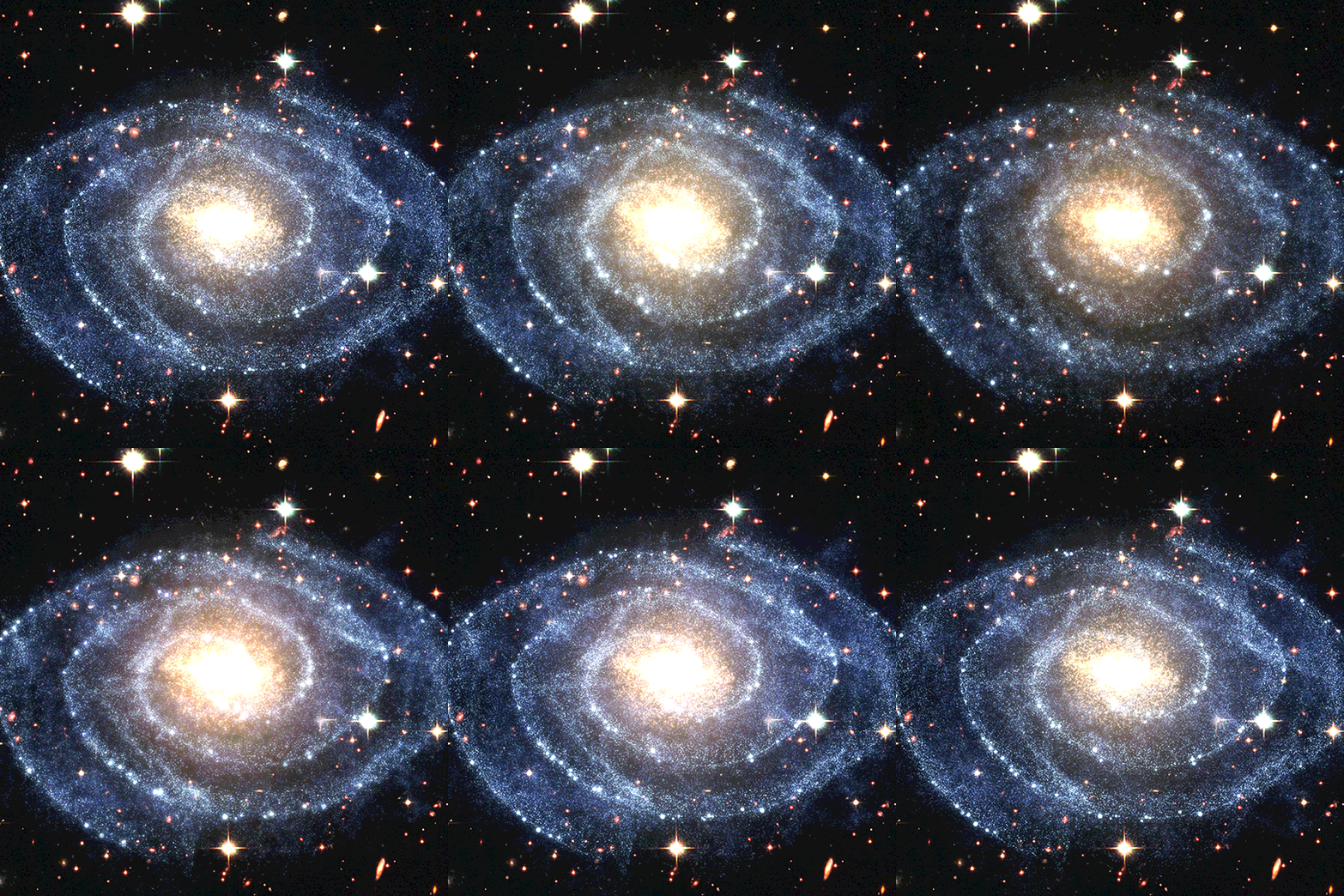
The first time most people point a telescope at a “smudge” a star chart promised was a galaxy, there’s a brief moment of doubt — is that really it? That gray, faint, slightly-off-round patch of light is 2.5 million light-years away, and yes, that’s really it. Learning to find and appreciate deep-sky objects is less about equipment and more about knowing where to look and what to expect once you get there. That’s exactly what the Messier catalog was built for, and it’s still the best starting list beginners have.
This post mentions specific gear categories. Some links are affiliate links, meaning we may earn a commission if you buy through them, at no extra cost to you. See our affiliate disclosure for details.
Why the Messier Catalog Is Still the Best Beginner List, 250 Years Later
Charles Messier was a comet hunter in 18th-century Paris, and the objects in his catalog weren’t the point — they were the annoyance. Every time he found a fuzzy patch that stayed put instead of moving across the sky like a comet, he logged it so he’d stop mistaking it for a real discovery. He ended up cataloging 110 of the sky’s brightest star clusters, nebulae, and galaxies almost by accident, and in doing so built the single best target list a beginner can work through today. Every Messier object is bright enough to matter, interesting enough to be worth the hunt, and well-documented enough that you’ll always know if what you’re looking at is actually what you found.
If you’ve already spent time working through choosing your first telescope and you’re staring at a dark sky wondering what to actually point it at, the Messier list is where that question gets answered.
What You Actually Need
Less than you’d think. A lot of the best Messier targets are bright enough to spot in a decent pair of 10×50 binoculars before you ever put a telescope on them, which is genuinely the best way to learn the sky — wide field of view, no fussing with a finder scope, and instant feedback on whether you’re pointed in the right direction. Beyond that, you want a red-light flashlight to protect your night vision while reading a chart, a star chart or planetarium app (we compared the popular options in our guide to star charts and planetarium apps), and a genuinely dark sky. Light pollution is the single biggest thing standing between you and seeing these objects well, more so than aperture or magnification.
Five Messier Objects to Start With Right Now
Mid-to-late August into September is one of the best windows of the year for this, because you get the last of the summer Milky Way targets low in the west during early evening while Andromeda and the autumn sky are already climbing in the east by 9 or 10 p.m. Here’s where to start.
M13 — The Great Hercules Cluster
A globular cluster packing roughly 300,000 stars into a ball about 145 light-years across, sitting some 25,000 light-years away in the constellation Hercules. In binoculars it’s a soft, slightly grainy glow; in even a modest telescope at higher power, the outer edges start resolving into individual pinpricks of starlight, which is genuinely one of the best “wow” moments available to a beginner. It’s high overhead for Northern Hemisphere observers on August evenings, which makes it an easy first target.
M31 — The Andromeda Galaxy
This is the big one: the nearest large spiral galaxy to our own, and the most distant object most people will ever see with the unaided eye. By late August and into September, the Great Square of Pegasus clears the eastern horizon by around 8–9 p.m. at mid-northern latitudes, and a line traced from the Square through the star Alpheratz points you almost straight at it. Through binoculars or a small telescope it shows up as an elongated, hazy oval with a brighter core — not the sweeping spiral-arm photograph you’ve seen, but genuinely striking once you register what you’re looking at.
M27 — The Dumbbell Nebula
A planetary nebula in Vulpecula, the gaseous shell puffed off by a dying sun-like star. It’s one of the brightest and easiest planetary nebulae for a beginner, showing an distinct hourglass or “apple core” shape even in modest telescopes, and it’s well placed overhead on August and September evenings.
M57 — The Ring Nebula
Smaller and dimmer than M27 but a rewarding target in the constellation Lyra, which is nearly overhead on summer and early-fall evenings, right near the bright star Vega. At low power it looks like a tiny, slightly fuzzy star; bump the magnification up and the classic smoke-ring shape starts to emerge.
M8 and M20 — The Lagoon and Trifid Nebulae
Grab these early in the evening while Sagittarius is still low in the southwest, before it sets. Both sit in the star-thick region toward the Milky Way’s core, and in a dark sky with binoculars you can catch both in the same field of view — the Lagoon as a soft glow around a loose star cluster, the Trifid smaller and fainter with its characteristic dark dust lanes needing a telescope and steady skies to really show.
How to Actually Find Them: Star-Hopping Basics
Before you rely on a GoTo mount, learn to star-hop — it makes you faster and more confident under any sky. The method is simple: start from a bright, easy-to-identify star or asterism, then use the angular distance and direction to a fainter reference star as a stepping stone, and repeat until you land on target. For M13, you hop from the “Keystone” asterism in Hercules. For M31, you hop from the Great Square of Pegasus or from Cassiopeia’s distinctive W shape, both of which point almost directly at the galaxy. A planetarium app on your phone (in red-light mode) makes this dramatically easier while you’re learning, since it shows you the exact hop in real time rather than asking you to memorize star patterns from a printed chart.
Setting Expectations: What You’ll Really See
This is the part beginners are rarely warned about clearly enough. Deep-sky objects through an eyepiece look nothing like Hubble images — those are long-exposure photographs, often in false color, stacked from data your eye simply can’t replicate in real time. What you’ll see visually is almost always grayscale, because the light-sensitive rod cells in your eye that work best in low light don’t register color well. Galaxies look like soft ovals of haze. Nebulae look like faint gray clouds, sometimes with a hint of structure. Globular clusters are the most rewarding for beginners precisely because they don’t rely on subtle color or contrast — they’re just a ball of individually resolvable stars, and that holds up beautifully even in a small telescope. Go in expecting faint, textured, black-and-white detail rather than a magazine cover, and the whole hobby gets a lot more satisfying.
FAQ
Do I need a telescope, or will binoculars work?
Binoculars genuinely work for a surprising number of Messier objects, especially bright clusters like M13 and wide targets like M31 and M8. A telescope adds resolution and reveals more structure, particularly on planetary nebulae like M57 and M27, but don’t wait to own a telescope before starting — binoculars you already have are a legitimate way to begin working through the list tonight.
Why do some Messier objects look like a smudge instead of the photos I’ve seen?
Because those photos are long-exposure astrophotography, not what the human eye sees in real time through an eyepiece. Your eye can’t integrate light over minutes the way a camera sensor can, so visual observing shows fainter, grayer, less detailed versions of the same objects. That’s normal, not a sign you’re doing anything wrong.
What’s the best time of night to hunt Messier objects?
Aim for at least an hour after full darkness, once your eyes have had time to dark-adapt, and ideally on a night with little to no moon in the sky, since moonlight washes out faint nebulae and galaxies fast. Check our moon phases and best viewing times guide if you want to plan sessions around the lunar calendar.
The Messier catalog isn’t a checklist to rush through — it’s a season-by-season companion that rewards patience. Start with the five objects above, get comfortable star-hopping to them without help, and the rest of the catalog starts opening up on its own. For more on getting your gear and technique dialed in first, see our full stargazing guide.
Further reading: NASA’s Hubble Messier Catalog and EarthSky’s guide to finding the Andromeda galaxy.